


12 Apr Navigating a Strait of Uncertainty
Global markets have quickly been swept up in the disruptive effects of the US and Israel’s offensive on Iran. The most affected were Iran’s Middle Eastern neighbours, as Iran counter-attacked by launching strikes on nearby nations that housed US military bases. As the conflict has ensued, Iran has been severely damaged, and the reach of the conflict’s disruptions has spread. Central to Iran’s war strategy is applying pressure on US President Donald Trump by effectively closing the Strait of Hormuz, a key passage for seaborne oil exports from the Gulf nations as well as other significant commodities. These exports account for 20-25% of global oil exports, about 20% of Liquefied Natural Gas trade, as well as significant fertiliser volumes. Iran’s underlying strategic rationale is that Trump is particularly sensitive to market woes, so closing the Strait, which has caused oil and other key commodity prices to skyrocket, puts political pressure on the president to back off in the war.
The situation has been further complicated by shifting strategic signals from the United States. Public statements from the administration have varied significantly, ranging from demands for decisive outcomes to indications of limited engagement, as well as evolving positions on the management of the Strait of Hormuz. These fluctuations make it difficult to form a clear view of long-term geopolitical intentions. Fortunately, we are not in the business of geopolitical prognostications. However, we do design our offerings with geopolitics in mind.
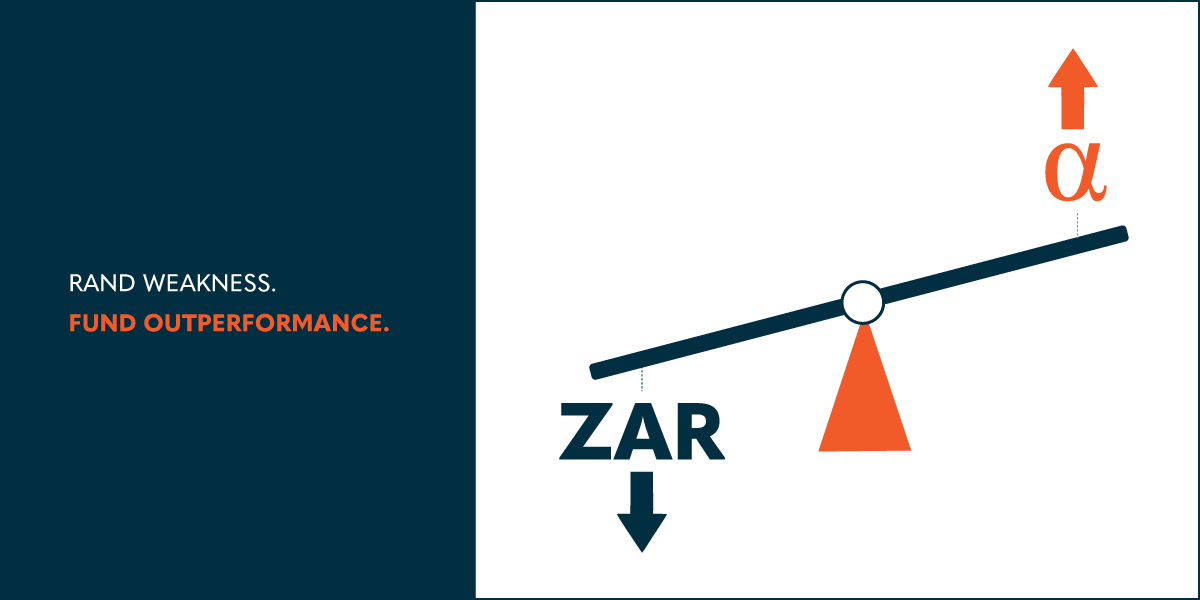
Following the disruption caused by the war and up until the end of March, the JSE All Share Index is down 11.3%, and the Rand has depreciated 6.3% against the Dollar, from 15.94 to 16.94. The mechanism is straightforward: a surging oil price raises input costs globally, triggering a risk-off rotation in which emerging market currencies like the Rand take the hit as capital flees to the safety of the Dollar. The High Street Balanced Prescient Fund, with its +90% Rand-hedge, is built precisely for this environment. As the Rand weakens, the Fund’s offshore and Rand-hedge exposure appreciates in Rand terms, cushioning the blow that unprotected portfolios absorb in full. The result: although down 3.8% since the war began on the 28th of February 2026 up to the end of March, the fund has delivered 2.0% alpha against all funds in our ASISA category. The risk-off mechanism worked similarly during quite a different disruption: the outbreak of COVID-19. During the COVID selloff (January–March 2020), the Rand depreciated 27.4% against the Dollar, from 14.00 to 17.84, and the High Street Balanced Prescient Fund delivered 9.6% alpha across the broader ASISA category. For South Africans saving for retirement, this is not a fortunate coincidence; it is the portfolio doing exactly what it was designed to do.