


06 May The geographic building block drawing the attention of allocators
A Regulation 28 fund with a global mandate. True diversification built to compliment an investor’s portfolio especially during bouts of market turbulence, both locally and abroad.
Written by: Ross Beckley
Chief Investment Officer
High Street Asset Management
Source: High Street Asset Management via Bloomberg. Data as of 31/12/2024
‘90%+ effective Rand-hedge exposure’ and ‘Regulation 28 compliance’ do not usually go hand in hand. This is what makes the High Street Balanced Prescient Fund (“Fund”) unique, it is built to follow a global strategy while providing the advantages associated with retirement savings.
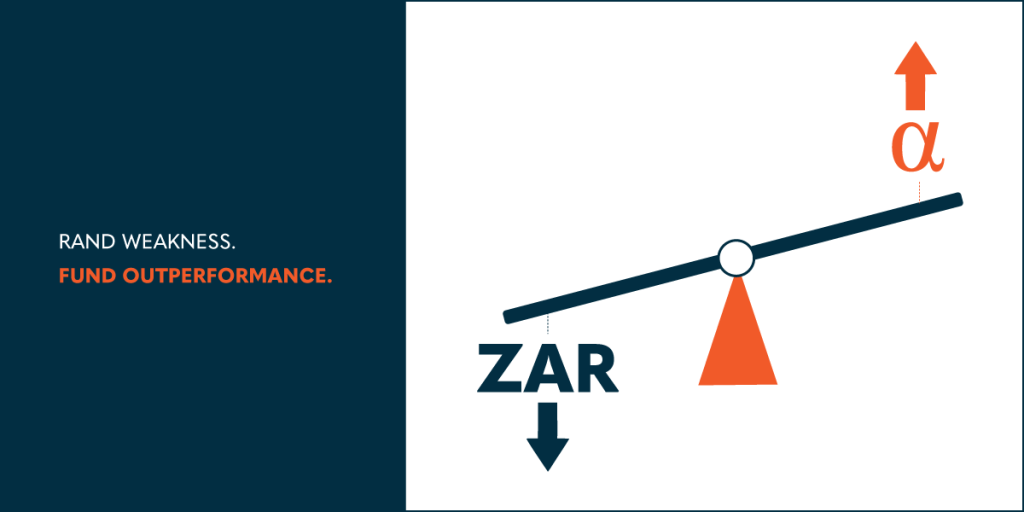
The effectiveness of the 90%+ Rand-hedge is illustrated above. When the Rand weakens, the Fund outperforms and generates significant alpha compared to peers*. This is of particular relevance given the recent outbreak of the war in the Middle East. The Fund has delivered on its mandate generating notable alpha, as a weakening Rand acts as a shock absorber during times of global market turmoil.
But how does a Regulation 28 fund achieve this? Two levers. First, the Fund deploys its full 45% direct offshore allowance into international assets that earn and report in more stable offshore markets. Second, the remaining local allowance is invested exclusively in Rand-hedge companies like Glencore and Richemont, whose revenues are anchored in global markets, not South Africa. These opportunities present themselves in select local equity and listed property investments.
High Rand-hedge exposure cuts both ways and 2025 tells this story. The Fund returned 13.8% against a peer average of 18.9%** as the Rand rallied strongly against the US Dollar. However, since inception, the Fund has returned 13.2% p.a. against the benchmark’s 11.7%, generating meaningful alpha. Over the past decade, the Rand has weakened in eight out of ten years. 2025 was one of the exceptions and this is part of the appeal of the Fund’s mandate.
Source: High Street Asset Management via Bloomberg. Data as of 31/12/2024
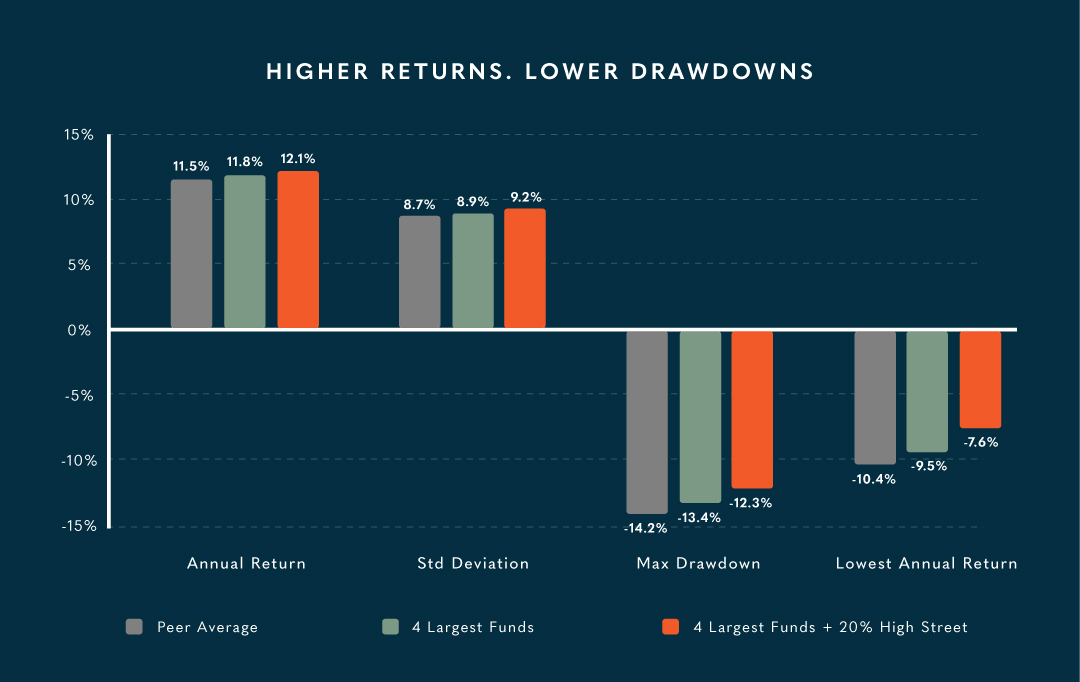
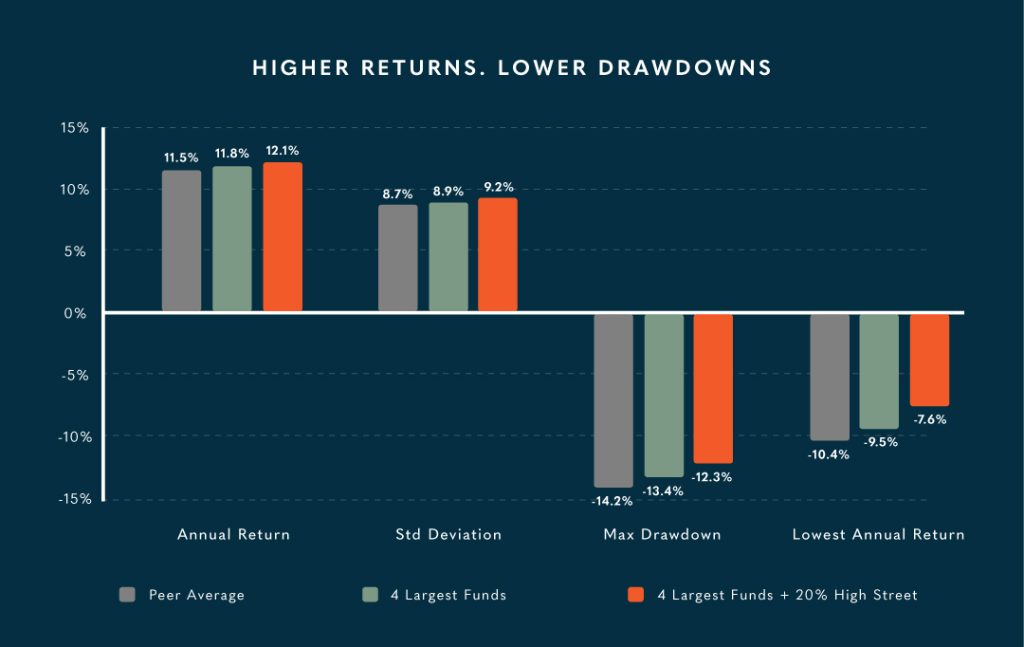
The four largest SA balanced funds (“Big 4”) have an average correlation of 0.92 to the category peer average, meaning they tend to perform very similarly to one another. In comparison, High Street Fund’s correlation is 0.61, which means that its inclusion in a portfolio may increase diversification and reduce overall portfolio risk. When included in an equally weighted portfolio with the Big 4, annualised returns increase, volatility rises only marginally, and max drawdowns are lower as illustrated above. The results confirm that it behaves like a theoretical global building block offering geographic diversification for Regulation 28 investors which is difficult to replicate. This may be particularly attractive to
DFMs and advisers who opt for a building block approach to portfolio construction, given the Fund’s stable geographic and asset allocation.
“The Missing Link in a Portfolio of Funds.”
The Fund’s volatility is elevated but this is largely driven by movements in the Rand exchange. If a South African invests in developed market government bonds and measures their returns in Rands, the historical volatility is greater than the average local balanced fund. Does this imply South African balanced funds are less risky than investment grade developed government bonds? We believe a more tangible measure of risk is the likelihood of failing to achieve your target return objective which, for most retirement savers, is generally SA CPI +5% per annum. On a rolling one-year basis, the Fund has achieved its target return 73% of the time against a peer average of just 53%. Over a rolling five-year period, 100% of the time against a peer average of 60%. This consistent long-term performance is driven by High Street’s internal investment process, HighWay TM , which holds the mandate to its parameters through every market cycle.
The geopolitical pressures of early 2026 – Middle East conflict, US tariff uncertainty, and a fragile Government of National Unity coalition at home – are precisely the conditions under which the Fund could add stability to a portfolio of funds.