
16 Mar The Halo Effect
The finance world loves an acronym, and the “HALO Trade” is the latest example. Standing for “Heavy Assets, Low Obsolescence”, it captures the recent shift in investor sentiment away from AI-driven, tech-heavy companies and toward businesses perceived as more resilient, tangible, and enduring. Essentially, it is a return to the old “boring” sectors of the economy, industrials, materials, and consumer staples. Industries where competitive advantage is rooted in physical assets, entrenched infrastructure, and long replacement cycles rather than rapidly evolving lines of code.
As AI adoption accelerates and becomes more deeply embedded in corporate workflows, investors are increasingly questioning the durability of companies heavily exposed to software and cloud ecosystems. There is growing concern that many of these specialized tools will be swallowed up and turned into a single ‘add-on’ feature within bigger AI systems. The HALO Trade, therefore, represents a search for stability amid uncertainty, even though little evidence currently suggests that large language models can replicate the full value these companies provide.
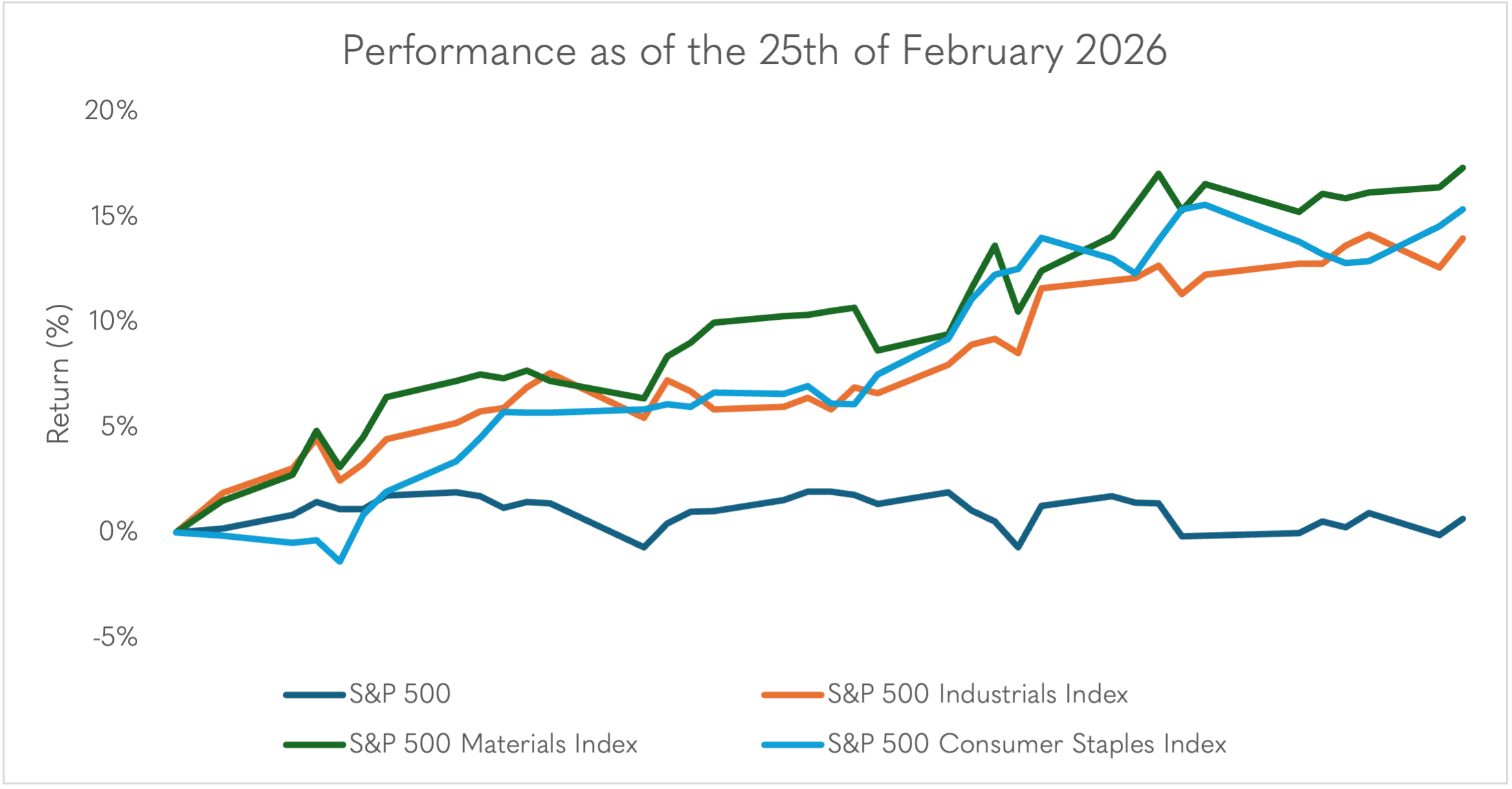
Software-as-a-Service (SaaS) names have been among the primary casualties of this rotation, suffering sharp year-to-date declines. Salesforce (-27%), Adobe (-23%), and Snowflake (-26%) have all fallen significantly, as investors fear that AI could reduce the number of subscriptions these companies sell and compress renewal rates if customers replicate certain functionalities in-house. Even traditionally defensive financials have come under pressure, with S&P Global (-18%) experiencing a notable sell-off amid concerns that AI-enabled automation could erode core revenue streams in its credit ratings and financial data analytics businesses. By contrast, the rotation has produced clear short-term winners. The S&P Industrials, Materials, and Consumer Staples indices have outperformed the tech-heavy S&P 500 year-to-date, with companies such as John Deere (+38%) and Caterpillar (+28%) benefiting as investors rotate toward the “real economy.”
At High Street, the durability of a company’s business model is a core consideration and is fully embedded in our investment process. While short-term turbulence has put some of the names mentioned under pressure, our team believes that over the medium to long term, the impact of AI on SaaS will likely be concentrated in businesses offering a single, specialised function, which can be more easily absorbed into broader AI platforms. Integrated solution providers, such as Salesforce, that are embedded across multiple workflows and governance controls are less exposed and benefit from strong competitive moats rooted in switching costs, compliance, trust, and deep integration. Ultimately, the HALO Trade highlights the importance of investing in resilient business models with enduring advantages, particularly as technological disruption continues to reshape market expectations.